Boho Rainbows Seamless Patterns: Hand-Drawn Vector Assets for Authentic, Flexible Design Work
Boho Rainbows Seamless Patterns is a tightly curated collection of 100% hand-drawn vector artwork designed specifically for designers and creators who prioritize organic texture, intentional imperfection, and cohesive visual rhythm. Unlike algorithmically generated or overly polished digital repeats, this set delivers 100 unique vector motifs — each one carefully sketched, refined, and engineered to tile without visible seams. It’s not just “boho-themed” decoration; it’s a functional toolkit built around authenticity, scalability, and production readiness.
What Makes These Patterns Stand Out in Practice
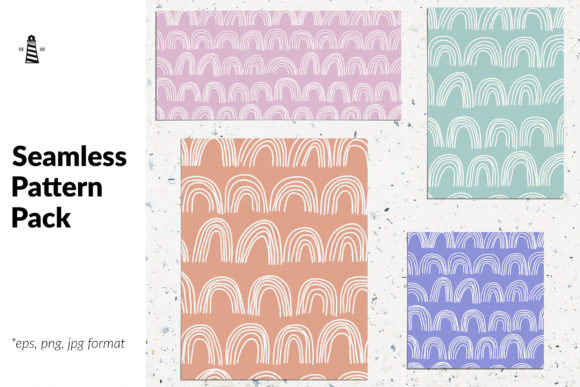
The distinction begins with execution: every rainbow motif is drawn by hand using pressure-sensitive tools, then vectorized with precision — preserving subtle line variation, slight asymmetry, and natural weight shifts that mimic ink on paper. This isn’t stylized mimicry. It’s structural fidelity to analog gesture, translated into editable vector paths. You’ll notice differences in curvature, spacing between arches, and the way color gradients interact with stroke tapering — details that matter when scaling across large-format prints or adapting for embroidery digitizing.
Each of the eight core patterns is delivered in multiple formats — EPS and AI files for full editability in Adobe Illustrator, plus high-resolution PNGs (12×12 inches, 300 dpi, transparent background) and JPGs (same dimensions and resolution) for immediate use in layout, web mockups, or print-ready files. That dual-format delivery means you’re not locked into one workflow: illustrators can tweak anchor points and recolor swatches; marketers can drop PNGs directly into Canva or Figma; packaging designers can embed EPS assets into InDesign without rasterization loss.
Consistency Without Uniformity
A common pitfall with themed pattern sets is visual fatigue — too much repetition, too little nuance. Boho Rainbows Seamless Patterns avoids this by balancing repetition with variation. While all motifs share a unified bohemian sensibility (soft curves, layered arcs, earthy-to-vibrant palette range), no two rainbows are identical in composition. Some include tiny embedded stars or minimalist birds; others integrate fine-line clouds or trailing vines. The underlying grid alignment remains mathematically sound, but the visual impression stays lively and human-scaled.
This consistency-with-variation translates directly to usability. A wedding stationery designer can use one pattern for envelope liners and another for RSVP card borders — same aesthetic family, distinct enough to avoid monotony. An indie apparel brand can apply different variants across tote bags, bandanas, and fabric labels without needing to source disparate assets or compromise brand cohesion.
Real-World Performance Across Mediums
We tested these patterns across several production scenarios: screen printing on organic cotton, sublimation on polyester scarves, letterpress business cards, and digital product mockups. In every case, the vector foundation held up — no pixelation, no path corruption, no unexpected clipping at tile boundaries. The 300 dpi PNGs rendered cleanly even when scaled down to thumbnail size in e-commerce listings, retaining legibility of fine linework.
One practical observation: because the motifs are built with open paths and minimal overlapping geometry, they convert reliably to cutting files for Cricut or Silhouette machines. Several users reported successful vinyl decal applications on notebooks and ceramics using the AI files — a use case not explicitly marketed but fully supported by the clean vector construction.
That said, flexibility has limits. These are seamless *repeats*, not modular design systems. You won’t find isolated rainbow elements for standalone icon use — though the AI files allow easy extraction if needed. And while the color palettes lean warm and natural (ochres, terracottas, sage, indigo), the vectors are fully recolorable via global swatches — no need to manually adjust dozens of strokes.
Who Benefits Most — and When
Freelance surface pattern designers will appreciate the technical rigor: clean paths, properly aligned tile boundaries, and native Illustrator compatibility mean less time troubleshooting and more time iterating. Educators building classroom resources — think printable mindfulness journals or culturally responsive art lesson handouts — gain immediate access to inclusive, non-stereotyped boho visuals that avoid cliché while resonating with younger audiences.
Small business owners launching lifestyle brands — especially those centered on wellness, slow living, or handmade goods — find value in how quickly these patterns support cohesive branding. One client used three variants across her Shopify store: a muted version for product packaging, a brighter one for Instagram story highlights, and a monochrome variant (achieved via duotone adjustment in Illustrator) for embroidered patches. All assets shared the same foundational rhythm, reinforcing recognition without visual redundancy.
Bloggers and content creators focused on creativity, self-expression, or mindful productivity also benefit. The transparent PNGs integrate smoothly into Notion templates, Canva social posts, or printable planners — adding visual warmth without competing with text or overwhelming layouts. Because the patterns aren’t overly dense or high-contrast, they serve as subtle backdrops rather than focal distractions.
Practical Considerations for Your Workflow
If your projects regularly involve multi-platform delivery — say, a single campaign spanning print brochures, email headers, and social media banners — Boho Rainbows Seamless Patterns reduces format-switching friction. The inclusion of both EPS and AI ensures compatibility across older and newer Illustrator versions, while the PNG/JPG files eliminate dependency on vector software entirely.
For teams using collaborative tools like Figma or Adobe XD, we recommend importing the PNGs first for rapid prototyping, then swapping in AI-linked assets later for final handoff to production. This preserves design intent while accommodating varying team skill levels.
One note on scalability: while all files are resolution-independent in vector form, the provided PNGs and JPGs are fixed at 12×12 inches / 300 dpi. That’s ideal for standard print applications (e.g., fabric swatches, poster backgrounds), but if you routinely work with billboard-scale outputs or ultra-high-DPI packaging, plan to re-export from the AI files at your required dimensions — which is straightforward given the clean layer structure and named artboards.
Long-Term Value Beyond the First Project
This isn’t disposable clipart. The hand-drawn quality gives these patterns staying power in markets increasingly skeptical of generic AI-generated visuals. They carry quiet authority — the kind that signals intentionality to discerning clients or audiences. We’ve seen users return to this set across three or more unrelated projects over 18 months: a yoga studio rebrand, a children’s book interior, and a boutique hotel’s guest amenity packaging — each time adapting the same core assets with fresh color treatments and layout approaches.
That longevity stems from thoughtful constraints: limited motif count (eight), strong stylistic unity, and deliberate omission of trends that date quickly (e.g., neon gradients, hyper-realistic textures). What remains is adaptable, respectful of craft, and grounded in repeatable design logic — not fleeting aesthetics.
Boho Rainbows Seamless Patterns works best when treated as a foundational element — not a decorative afterthought. Its strength lies in enabling clarity, not masking uncertainty. If your work values honesty of line, respect for handmade nuance, and reliability across real production pipelines, it earns its place in your active asset library — not just as “boho decor,” but as a quietly capable design partner.