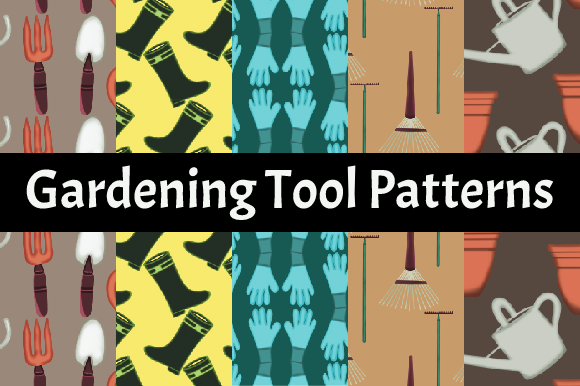
Gardening Tool Patterns: Practical Design Assets for Creative Professionals
For designers, marketers, educators, and small business owners who regularly develop visual content, Gardening Tool Patterns offer a focused, high-resolution resource that bridges thematic relevance with production-ready utility. These aren’t generic botanical motifs or vague nature illustrations — they’re precisely composed arrangements of essential gardening tools: trowel, handfork, gloves, pesticide bottle, wheelbarrow, fork, saw, flower pot, watering can, boots, and rake. Each pattern is built around real-world recognition and functional clarity, making them immediately adaptable across multiple creative workflows.
Where Gardening Tool Patterns Fit in Your Visual Production Workflow
Visual assets like Gardening Tool Patterns rarely exist in isolation. They enter your process at specific inflection points — often when you’re moving from concept to execution. For example:
- Before a project: You might select one of the five patterns during mood board development or brand alignment exercises — especially if launching a garden supply e-commerce site, planning a sustainability workshop, or designing packaging for organic seed kits.
- During production: A blogger creating seasonal gardening guides can drop a pattern directly into Canva or Adobe Express as a background for quote graphics or social media banners. A stationery designer may scale and layer elements to build custom notepads or gift tags without redrawing tools from scratch.
- After launch: These patterns support consistency. Reusing the same trowel-and-watering-can motif across email headers, printable checklists, and event signage reinforces visual continuity — no need to license disparate clipart or commission new illustrations each time.
This isn’t about decorative filler. It’s about reducing friction between intention and output — whether you're preparing teaching materials for horticulture students or building branded merch for a community garden co-op.
How These Patterns Interact With Other Tools and Platforms
Gardening Tool Patterns are designed to work alongside tools you already use — not replace them. Their 3000×3000 pixel size ensures crisp scaling in both digital and print contexts. That means:
- You can import them directly into Figma or Sketch for UI mockups (e.g., a gardening app dashboard background), then export optimized PNGs for development handoff.
- In Adobe Illustrator, you can place them as embedded raster layers and combine with vector text or icons — useful for poster design or logo variations where texture matters more than scalability.
- For educators using Google Slides or PowerPoint, dragging in a JPEG pattern creates an instant thematic slide background. No transparency issues, no licensing ambiguity — just plug-and-play reliability.
Because the patterns are non-seamless, they avoid the “repeating tile” effect common in generic backgrounds. This gives each layout a grounded, intentional feel — ideal when you want viewers to register the tools as meaningful symbols, not abstract texture.
Practical Implementation Tips for Real Workflows
Here’s how professionals actually use these patterns — drawn from real implementation scenarios:
Bloggers & Content Creators
Pair one pattern with a short seasonal tip (e.g., “Early Spring Soil Prep”) and overlay clean white text in a sans-serif font. Use the same pattern across a series — say, all four quarterly posts — to create visual rhythm. Since each of the five patterns features different tool groupings and layouts, you maintain variety without sacrificing cohesion.
Small Business Owners
If you sell handmade planters or organic compost, use a pattern featuring pots and gloves as wrapping paper for online orders. Print on kraft paper, fold cleanly, and seal with twine. Customers receive a tactile, on-brand unboxing experience — and you avoid costly custom printing runs.
Educators & Workshop Facilitators
Turn a pattern into a printable worksheet background. Add numbered sections for “Tool Identification” or “Seasonal Task Matching.” Because the tools are realistically rendered and clearly spaced, learners can annotate directly on PDFs or use them in interactive whiteboard sessions.
Freelance Designers
Include one pattern in your proposal deck when pitching to eco-conscious clients. It signals thematic fluency without overdesigning — a subtle way to show you understand their audience’s values before diving into color palettes or typography.
Factors That Impact Long-Term Usability
Five patterns may sound limited — but their value multiplies when you consider practical constraints:
- File format: JPEG delivers universal compatibility. No need to convert or troubleshoot EPS or SVG rendering across platforms. It works in WordPress media libraries, Shopify asset managers, and even basic email builders.
- Resolution: At 3000×3000 pixels, each file supports large-format prints (like 24×24" posters) while remaining lightweight enough for web use. You won’t hit upload limits on most CMS platforms.
- Organization: Name files descriptively — e.g., “Gardening-Tool-Pattern-03-Wheelbarrow-Fork-Pot.jpg” — so they’re instantly searchable in your digital asset library. Tag them with keywords like “garden tools,” “botanical,” and “educational design” for faster retrieval.
- Consistency: Because all five share the same resolution, style weight, and composition logic, mixing them in a single campaign feels intentional — not haphazard.
What’s notably absent — and intentionally so — is mock-up imagery. You receive only the patterns. That means no guesswork about what’s editable, no confusion about licensing third-party photos, and full control over how context shapes meaning.
Integration Without Overhead
Adopting Gardening Tool Patterns doesn’t require new software, training, or process changes. It fits into existing habits:
- Download the five files.
- Add them to your go-to design folder — alongside fonts, brand colors, and standard templates.
- Next time you need a background, wrapper, or decorative element tied to gardening, sustainability, or hands-on learning, pull one from the set.
No onboarding. No subscription. No attribution required. Just immediate, reliable utility — especially valuable when deadlines tighten or client revisions pile up.
Realistic Expectations for Quality and Scope
These patterns excel where precision and recognizability matter — not where infinite scalability or photorealism is needed. If your project demands vector-based tool icons that resize infinitely, you’ll still need supplemental assets. But if you need a cohesive, thematic backdrop that communicates “gardening” at a glance — without visual noise or copyright risk — Gardening Tool Patterns deliver exactly that.
They’re calibrated for clarity, not complexity. Each tool is legible as an object, not just a shape — critical when designing for audiences ranging from children learning plant care to retirees selecting ergonomic tools.
Used thoughtfully, these five patterns become part of your visual shorthand: a quiet, consistent way to signal expertise, care, and grounded practicality — whether you’re illustrating a blog post, branding a local nursery, or preparing classroom materials for urban agriculture programs.