Magnolia Bloom Surface Patterns
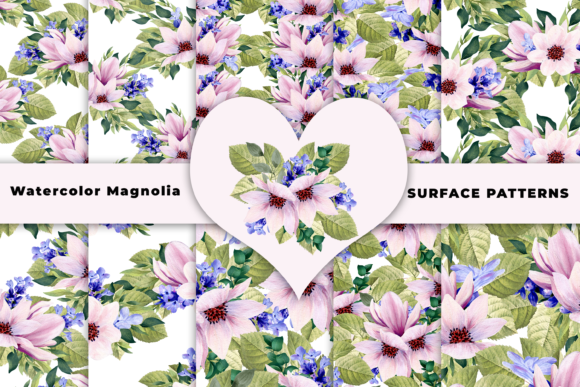
There’s something quietly powerful about a magnolia bloom—its soft curves, layered petals, and timeless elegance. When translated into surface pattern design, that quiet power becomes a versatile creative tool. The Magnolia Bloom Surface Patterns collection brings that botanical grace to life through hand-painted originals—each one crafted with intention, texture, and subtle variation. These aren’t algorithm-generated repeats or stock motifs; they’re illustrations born from real brushstrokes, ink washes, and careful observation of nature’s rhythm.
Why hand-painted matters for real-world projects
When you’re designing for fabric, apparel, or product packaging, consistency alone isn’t enough—you need character. Digital vectors often feel crisp but flat; AI-generated patterns can lack cohesion or emotional resonance. The Magnolia Bloom Surface Patterns collection avoids both pitfalls. Because each motif is hand-painted, the textures breathe: faint watercolor granulation, gentle pigment pooling, slight irregularities in petal edges—all preserved in high-resolution files. That authenticity translates directly into more tactile, memorable outcomes—whether it’s a baby onesie that feels heirloom-quality or a boutique soap label that stands out on a crowded shelf.
Designed for flexibility—not just aesthetics
You’ll receive 10 unique surface patterns, each delivered as a 5000×5000px PNG with transparent background and 300 DPI resolution. That size isn’t arbitrary. It ensures clean scaling across applications: sublimation printing on mugs won’t pixelate at the rim; large-format fabric yardage maintains clarity even when repeated across six meters; blog headers stay sharp on retina displays. The transparency means no time wasted removing backgrounds—just drag, drop, and adjust tiling in your preferred software (Adobe Illustrator, Procreate, Affinity Designer, or even Canva with proper layer handling).
This flexibility supports real workflow efficiencies. A small-batch clothing brand can test a single Magnolia Bloom pattern across three garment silhouettes—tote bag, romper, and bandana—without reworking assets. A wedding stationer might use one pattern for invitation borders, another for envelope liners, and a third subtly as a watermark behind RSVP text—all while maintaining visual harmony. No need to license separate motifs or hire an illustrator for cohesion.
Where these patterns deliver measurable value
Fabric & apparel designers benefit most when working with natural fibers or eco-conscious lines. The organic imperfection of hand-painted blooms complements linen, organic cotton, or Tencel—materials where rigid geometry would feel out of place. One designer recently used Pattern #4 (a looser, asymmetrical repeat) for a line of gender-neutral kids’ pajamas; parents noted how the “softness” of the print matched the fabric’s drape and comfort.
Small business owners creating physical products—think candle labels, ceramic decals, or sticker sheets—appreciate the ready-to-print quality. Sublimation users report excellent color fidelity, especially with soft pinks, sage greens, and warm creams common in the collection. Because the patterns are seamless and built for repeat, there’s no visible seam-line ghosting on curved surfaces like mugs or cosmetic jars.
Content creators and educators find unexpected utility here too. Bloggers embedding floral motifs into tutorial graphics or printable classroom resources gain visual warmth without copyright risk. One Montessori teacher used Pattern #7 as a subtle background for a set of plant-life vocabulary cards—students responded more readily to the hand-drawn quality than to sterile clipart.
Practical considerations before you begin
While highly adaptable, these patterns work best when aligned with their inherent mood. They lean toward calm, refined, and gently nostalgic—not bold, futuristic, or high-contrast. If your brand identity centers on neon gradients or industrial typography, these may require thoughtful pairing rather than standalone use. Likewise, for ultra-minimalist branding (e.g., monochrome sans-serif + negative space), consider using them sparingly—as a single accent tile or cropped detail—rather than full-coverage repeats.
The transparent background is ideal for digital overlays but requires attention in physical production. For screen printing or embroidery digitizing, you’ll need to convert transparency to white or base-layer color depending on substrate. Always soft-proof on your intended output device first—especially with delicate watercolor-like edges that may render differently on coated vs. uncoated paper stocks.
Real projects, not just potential
A few examples illustrate how users have moved beyond “pretty background” into functional design:
- A baby shower planner used Pattern #2 (a tighter, circular repeat) to create custom vinyl decals for nursery wall art—scaled down to 4 inches, the fine petal details remained legible and charming.
- A scrapbooker layered Pattern #9 over scanned vintage lace scans in Photoshop, adjusting blend modes to create dimensional, heirloom-style page backgrounds.
- A children’s book illustrator licensed the collection to develop consistent endpaper designs across three titles—maintaining continuity without repeating identical layouts.
These aren’t hypotheticals. They reflect how the Magnolia Bloom Surface Patterns collection functions in actual creative pipelines—where speed, authenticity, and adaptability intersect.
Supporting your creative process—not replacing it
This collection doesn’t promise to “solve design.” Instead, it removes friction: no hunting for royalty-free assets that lack cohesion, no hours spent masking or recoloring generic florals, no uncertainty about print readiness. You retain full control—flip repeats, recolor palettes, isolate individual blooms for custom illustrations, or combine motifs to build new composites. That autonomy is especially valuable for freelancers juggling multiple clients or educators preparing materials across grade levels and subjects.
If you’re building a cohesive brand language—or simply want to elevate everyday projects with quiet sophistication—the Magnolia Bloom Surface Patterns offer grounded, human-made quality you can rely on. And if you do create something meaningful with them? The designer invites you to share it—tag andreea_eremia_design on Instagram. Not for promotion, but to witness how thoughtfully made tools ripple outward into real work, real spaces, and real connection.